Independent Candidate – Eilean a’ Cheò by-election 19 June 2025

Tag: community

  • Blaidhna Mhath Ùr – Happy New Year folks!

    Let’s start with last year not at all being what I expected. I have now had 6 months as a Highland Councillor and I am still delighted. Thanks again to all who voted for me. Your support was such a boost. As part of the campaign, I wrote some blogs and really enjoyed it. It helped me to clarify what I was working towards. The plan is to write a few more. This time to focus on what I am doing.

    The blogs will cover what grabs my attention (and keeps it). There will inevitably be topics linked to The Highland Council (THC) but also crofting, collies, sheep, island life,  community development, land, ducks, kayaking and much more. If there’s a topic you would like me to explore, please get in touch!

    One topic that will come up is not overly subtle – I am neurodivergent. The ADHD has been confirmed – what an adventure that was! There is also strongly suspected autism, but we will save that for another blog. For me, confirming the ADHD has been like getting the right Haynes manual . It is a game changer. Knowing that every day starts fresh for me, means that creating a routine is day one every single day. As much as I would love to be someone that blogs regularly, I know that these blogs will not magically happen every week or month. But they will be shared when I can.

    That said, I will add a caveat. One of the best pieces of advice I have had since I started as a Councillor is that I have a new hat to add to the collection. This hat gives me inside information on what is happening with THC that it is not always appropriate to share. It is the same with being the director of a company/community organisation. There are rules and a code of conduct. This has a lot to do with why people have already said “you’ve changed”. My intentions are the same, but I cannot be. What I say can have an impact that was never previously a consideration. I will get things wrong; I have no doubt. I went white water kayaking with a friend last summer, and she reminded me that swims mean I am trying. I do not know everything. I will admit to mistakes and I learn. And what a lot I learned last year!

    One of the main things I have been learning about is planning. It is highly unlikely that I will be writing anything about planning. The best I can do is mention Planning Aid Scotland. They have resources, advice, information on projects, and much more. Why say this? I am on the North Planning Applications Committee. I am so thankful I like reading. One meeting had over 650 pages and that was just the agenda and reports. Then there’s the documentation, comments, and so much else. What it is allowing me to do is look at the Highlands from a completely new perspective.

    One of my personal aims this year is to complete a bit more of my MSc in Material Culture and Highland History. The new perspective will influence my writing. I cannot wait to get stuck in, finishing the papers, share it, and have the follow up conversations I know that will be sparked. As my friends will confirm, I can talk about some of my pet topics for ever. I love a good discussion.

    There is my one niggle. Discussion is a positive. Yes, I have been elected to bridge the gap between residents/communities and the local authority. It is an honour, privilege and significant responsibility. It also means that I am more visible as an individual than ever before. I am easily accessible – via email, mobile, in the shop, walking down the road. I am a local councillor living in the area I represent. I am a councillor, not a counsellor. I am not there to be ranted at. I am not a therapist. I am not there to be intimidated, harassed, or abused. I am still a person.

    There is a world of difference between should and reality. At this time of year, a lot of people will be putting pressure on themselves with the idea of should. They should be eating healthier. They should be fitter. They should go kayaking more often. They should be so many things. But where are they right now? This is the difference between should and reality – it’s the idea and the trying. The idea is the easy bit. The trying is finding ways that could make it happen. The capacity, the variations, the options, the resources, the support.

    The Haynes manual is there to help me find the way to try. A tractor is not built for an F1 race. A sports car isn’t going to better than an ATV on the hill. This time of year, I am thinking about what is good for me. What are the ideas that would work with some effort? I could try something and see how it fits with everything else around me. Last year did not go as I thought it would. I did not have standing for the Council in my plan but the opportunity arose so I decided I could try. That try took a lot of effort. It took a lot of time. That try has been one of the best decisions I have made. So, what will I try and do this year? Lets start simple with the next blog.
  • Personal and Professional

    I work in community development and representation because I followed my curiosity in history. I had worked in home care for a few years when I went back to Sabhal Mòr Ostaig in 2008 to improve my Gaelic. I did keep working in homecare at the same time as the full time first year course and I had always planned to go back into homecare. However, the appeal of the Minority Language and Community Development course was too much to ignore. The course allowed me to learn about the history, economics, politics, and culture of the Highlands and Islands, Scotland and beyond.

    Engagement, talking to people, is at the heart of development work. To me, engagement is making sure everyone knows the basics, knows where to find out more, how to engage with the project/organisation if they want to, and how to influence what is happening. I started working for the North Harris Trust in 2012 as their Engagement Officer as part of a graduate placement scheme with HIE. It was an excellent opportunity and provided valuable insight, training, and connections. Apparently, a good community engagement result was a response rate of 10-15%. The NHT Community Consultation had a 24% response rate for households. We even tailored the survey so that the local school children could add their own responses.

    Working with communities can be a challenge, and I love finding ways through the challenges that we face. The key to it is respecting all involved. Sometimes, we need to wait for the right set of circumstances or the right people. When I worked for the Muaitheabhal Community Wind Farm Trust as their Development Officer (DO), I updated the Park and Kinloch development plan. This plan required working with all of the organisations in their area. It took a lot of coffee and cake, but we did it! You can see the report here. There are two priority benefits to a detailed plan like this

    • the community themselves can see exactly what is being planned in one place
    • funders see how their funding tied into a much wider plan.  

    Much of what I have worked in is a mix of a translation service. What one person needs to understand something is not the same for everyone. Some people want basic info and pictures, others want a spreadsheet, others want a reel. Funding priorities are one of my favourites. The work I have done on Raasay is a great example of what can be achieved when working together and keeping everyone involved.

    Raasay Development Trust (RDT) was established in 2014 to take on projects to support the island to thrive. In May 2022, Raasay was announced to have been chosen as one of six islands to be funded through the Carbon Neutral Islands project. As a Director, I worked in the background to support the Development Officers. The first job was to get the community involved. The plan included drop-in sessions, events, and creating a household survey. With two part time Development Officers that went round to help with filling in the form, we managed to get a massive 86% response rate. The resulting Community Climate Action Plan can be found here

    Raasay has an incredible number of groups and organisations for such a small island. It took a monumental effort, time, and resources to complete the first years’ outcomes on time and within budget. If extra information is needed, we know who to talk to. I hope the lasting legacy is the continuation of the round table meetings of all the organisations. In any community, it can be difficult to keep conversations respectful. No matter the subject, there are always nuggets of information there that people agree on. Development officers, councillors, and other are here to help find those nuggets and keep us all working together for the benefit of all. It can be surprising when you pare away the layers of an argument and find the same concern.

    When I worked with Community Land Scotland as the Gaelic Development Officer, groups always knew they would be able to ask me anything. Some of the best projects come from a “silly idea” that someone wanted to run by me. Knowing you can contact someone, and get a supportive response, builds confidence in whatever you are involved in. I have always been easily contactable, no matter the role, that will not change.

    Like community development officer, being a Councillor is representing the community, not your personal views. That must never be lost in the work that is prioritised and brought forwards. As a development officer, you are there to represent and advocate for the communities. As a councillor, I will be the local voice for the people of Skye and Raasay.

    PS – Before you ask, in the Highlands especially, you will only get 100% engagement if you’ve infuriated the locals!

  • Tourism, Tax, and Time

    There are two points within the discussions around tourism that I want to look at – the income from tourism, and the impact of tourism. There are areas where those impacted are being compensated, but there are too many areas where the impact brings only negatives.

    We know the proposed Visitor Levy/Tourist Tax is not fit for purpose. Scottish Government legislation does not support the nuance of diversity in local authority areas. It requires too much administration for both sides, did not take into account what the stakeholders said (businesses, communities, or local authorities), and missed out key tourism groups (camper vans and cruise ships) . We do need some sort of taxation but this is not it.

    Lets look at a suggestion for accommodation providers. It is common all over the world to have some sort of fee for staying in holiday accommodation. I would rather a simple flat rate that is linked to three things –

    • the property (or properties),
      • is this a family home that’s being rented out?
      • a purpose bought property to make money?
    • impact on local housing stock
      • is it a purpose-built pod?
      • an ex-council house?
    • the impact on others
      • is it in a quiet location with no impact on others down a private road
      • right beside other properties that will have a significant impact on parking/noise/disturbance?

    The future of tourism in Scotland needs to take more consideration on the impact, quantity, and quality. It needs to take everyone into consideration. Those with only a few days to see something they’ve always wanted to, travel for work or a medical appointment, those on a budget, those wanting a month in a hut to write a novel, and especially those that live and work here.

    There’s an old joke about Gaelic not having a word for the urgency of mañana. It is that attitude of going slowly to appreciating what is here that I would like to see as the focus for tourism. Come over, enjoy the hospitality, take your time, tour about, talk to people, see the sights. It takes the pressure off everyone.

    When I started working for the North Harris Trust in 2012, developing the shoulder season was our priority for tourism. How could we get people to come and stay around Easter and towards the autumn? Was there a way to get away from just the summer rush? I think we can all agree that the tourism season is well and truly extended.

    The issue now is the vast number of people coming to visit. Add to that, how few stay for more than a night or two. They’re in a rush to tick the boxes and then head off again. It is intensive for everyone involved and we are all aware of the impact at the various tourist hotspots.

    The impact is not just the impact on housing, roads, and infrastructure. We are seeing it when people avoid going to certain places, do not visit local shops, do not go to the cafes. People cannot get access to fields because the gate is blocked.  And we all must remember where the Highland cows might be – there will be cars stopped in the middle of the road!

    Many livelihoods are linked to tourism. They quite rightly should be – it is not a new phenomenon. What I will work towards is balancing the potential of the tourism industry with the impact on the people, communities, and businesses that are also here.

  • Out and About

    When I started working through everything I needed to do as part of my very first political campaign, I never thought I would enjoy canvasing as much as I do. Getting out and talking to folk I’ve not seen for years, meeting new people, hearing what is going on – I am thoroughly looking forward to getting out next week.

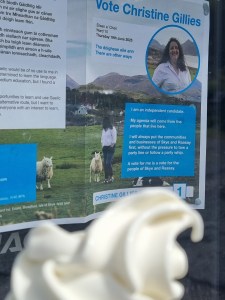
    In the last week I’ve been to Kyleakin, Breakish, and parts of Sleat and Broadford. I’ve been to houses, businesses and even a few sheds! Thankfully, most people have got a copy of my leaflet in the post already, so folk are aware that I’m standing. There have been a few that haven’t got them through yet – I know the posties are extremely busy right now so entirely understandable – and fortunately I have lots of spare leaflets ready to share.

    The support I have received from businesses – putting up posters for me and taking leaflets for customers is amazing. I am so thankful that folk appreciate my effort to stand in this by-election. It has been a leap into the unknown and what I am finding is fantastic.

    People that know me already know my passion for community, for advocating for the quieter voices that are often dismissed or ignored. In my years of working to ensure genuine engagement is developed, I have seen what is achievable once common ground is established. Often, that common ground is as simple as wanting the best for our communities. There is always a way to bring everyone to the table – my preferred method is sitting down and having a blether over cake and a cuppa!

    I am down at the Community Land Scotland conference at Sabhal Mòr Ostaig today, I’ll be at the shinty in Portree tomorrow afternoon, and I will continue my canvasing journey north on Monday. I am slowly but surely getting round Skye. However, I am on my own and Skye is much bigger than I can manage by myself. If I don’t come round to your house, I can only apologise – please get in touch if you have questions. I am prioritising getting to as many places as I can. If you want to help me by canvasing in your area, get in touch and I’ll get you some leaflets. Even talking to people makes a massive difference. Thank you for your continued support!

  • Why stand as an Independent Candidate

    Why stand as an Independent Candidate

    How did I get here?

    Standing as an independent candidate is thankfully nothing new here in the Eilean a’  Cheò Ward for The Highland Council. Following Calum Munro’s announcement at the start of the year that he was to stand down, I spoke to a few people, including Calum himself and John Finlayson, both Independent Councillors about what was involved. I considered the responsibility and how the workload would tie into what I am already doing. At no point did I think about joining a political party.

    What those conversations did confirm is that being a councillor is similar to the work of being a development officer, but on a different scale and slightly different way. I have worked in community development in variety of roles since 2012. The roles I have loved most have involved working with people to get their voices heard. This is a logical next step in my commitment to prioritising the needs and voices of the people.

    In high school, one of my favourite teachers was explained party politics to us in class. His explanation used buses. We are all trying to get somewhere specific, but the buses only follow a specific route. Party politics works in the same way. The political party is following their own policies and ideologies. So when you are voting it is for the one that gets you the closest to where you are wanting to be. Independent Councillors are like the small, flexible bus company that responds to the real needs of its local customers, rather than the pull to of honeypot destinations.

    I actually had someone ask me on my very first day canvasing if I was truly an Independent Candidate. I’ve never been a member of any party. Growing up around predominantly Labour voters has influenced me, but the modern parties are unrecognisable to their previous policies.

    Being an Independent Candidate means that you do not have the resources of a party machine, however it has opened my eyes to who is around me – from organising the leaflets, finding out how to book a door drop, social media accounts, the website, information packs, the nomination form – throughout all of it, I have been grateful and inspired by the amazing people who have stepped up and support me. I do not know everything, but I do know where to find the people that do. It takes a village to grow and Independent Candidate’s campaign.

    Far too often, a party agenda drowns out the voices of the people. I hear it so often that people feel ignored and overlooked. As an independent councillor, I can promise to put people front and centre.

    Anyone that’s met me knows that I love a blether. I talk through problems and opportunities with my friends. It is how I make sense of things. What makes the difference, what promotes change, is when we look at why there is an issue, what could be done collectively to fix it, and how to prevent it happening again. I am not looking for blame – I am looking for practical solutions.

    We saw during Covid the way communities were able to bypass the usual red-tape and create workable solutions to problems that arose. I am able to work between party politics in the same way. Often the answers have already been suggested. We need to listen and work together.

    My background in engagement has led me to be involved in making sure everyone in an area has their voice heard. My focus will be to make sure that the ways constituents can influence what is happening are as simple as possible. Community Councils need supported, information needs to be easily found.

    The election process has been entirely new to me. The staff of The Highland Council, the Councillors, and everyone else who is helping me find my feet, have been an invaluable network of support.

    I recognise that not everyone has a readily contactable network of support when faced with a problem. I have always been contactable when I’ve worked in a community support role, and as a Councillor I will be no different. We need to trust that those representing us are authentic, genuine, and will support us. I am doing this independently of a party because I believe that if I can rely on the people of Skye and Raasay to get me into The Highland Council, they can rely on me when I am there.

    Being an independent candidate is not just a personal choice; it is call for people to work together. Standing as an Independent Candidate is not a lack of conviction; it is the courage, conviction, and ongoing dedication to work for the people. This will be a challenge, but I have never been one to shy away. Together, we can prove it is a powerful force for meaningful progress.